On this page
- Key takeaways
- What are the pros and cons of narrating your own audiobook?
- Which books benefit most from author narration?
- How much time does it take to narrate your own audiobook?
- What equipment do you need to narrate an audiobook at home?
- How do you narrate your own audiobook step by step?
- How do you judge whether your test chapter is good enough?
- How do you protect your voice during a long recording project?
- What mistakes do authors make when narrating their own books?
- Is there a middle path between doing it yourself and hiring a narrator?
- How Cassell Publishers can help
- Frequently asked questions
- Sources
You should narrate your own audiobook if it is a memoir, teaching or faith book where your voice adds meaning, you read aloud clearly for long stretches, and you can commit about five to seven hours of work for each finished hour. For character-driven fiction, or if your time is limited, a professional narrator is usually the better investment.
Many authors love the idea of reading their own story. The question is not whether you can, but whether doing it yourself serves your book, your listeners and your calendar better than the alternatives.
Key takeaways
- Author narration works best for memoir, business, self-help and ministry books, where listeners value hearing you directly.
- The time cost is real: ACX estimates five to seven hours of work per finished hour for new narrators.
- The room matters more than the microphone. ACX files must hold a noise floor of -60dB or lower.
- A hybrid path exists: you perform, and a producer edits, proofs and masters.
- Record a test chapter first before you commit to the whole book.
What are the pros and cons of narrating your own audiobook?
The biggest advantages are authenticity and saving the narrator's fee. The biggest disadvantages are time, technical learning and the risk of a performance that falls short of what listeners expect.
| Factor | Narrating yourself | Hiring a professional |
|---|---|---|
| Authenticity | Strong for memoir and nonfiction; listeners hear the real you | A skilled interpreter of your words |
| Upfront cost | Equipment and possibly editing help | Typically $200 to $400 per finished hour |
| Your time | Five to seven hours per finished hour, per ACX | A few hours to cast, brief and review |
| Performance range | Limited for many character voices and accents | Trained in pacing, character and stamina |
| Technical quality | Depends on your room, gear and editing skills | Usually delivered to retailer specifications |
| Marketing value | Your voice becomes part of your brand, useful for podcasts and talks | Narrator's audience may follow the title |
| Control | Total control over tone and emphasis | Shared through direction and notes |
Cost figures in this guide are independent industry ranges for planning, not Cassell Publishers pricing.
According to ACX's guide to paying for audiobooks, narration runs roughly $200 per finished hour plus around $200 for post-production. That is the fee you save, and it is also a fair measure of the value of the hours you will spend.
Which books benefit most from author narration?
Books where the author's identity is the reason people buy benefit most: memoirs, personal essays, business books, self-help, sermons and devotionals, and family histories. Listeners want to hear the person who lived it or teaches it.
Character-driven fiction is the hardest case. A novel with many speaking characters, accents, or intense emotional scenes asks for acting skills that take years to develop. Some novelists do narrate their own work well, especially first-person stories with a voice close to their own, but it is the exception.
A useful test: if a reader would come to hear you speak at an event, they will probably enjoy hearing you narrate.
How much time does it take to narrate your own audiobook?
ACX estimates that new narrators need between five and seven hours of work to produce one finished hour. For a typical 80,000-word book, that means roughly 43 to 60 hours of recording, editing and review.
ACX's production guidance breaks a finished hour down into about two hours of recording, three hours of editing and 1.2 hours of quality review. It also notes that most performers narrate about 9,300 words per finished hour, which is how you estimate length.
| Book length | Est. finished hours | Est. hours of work (5 to 7 per finished hour) |
|---|---|---|
| 40,000 words | 4.3 | About 22 to 30 |
| 60,000 words | 6.5 | About 32 to 45 |
| 80,000 words | 8.6 | About 43 to 60 |
| 100,000 words | 10.8 | About 54 to 75 |
Your voice also limits your pace. Tone and energy change as your voice tires, so most narrators record in limited daily sessions, which is why author-narrated projects typically stretch over several weeks.
What equipment do you need to narrate an audiobook at home?
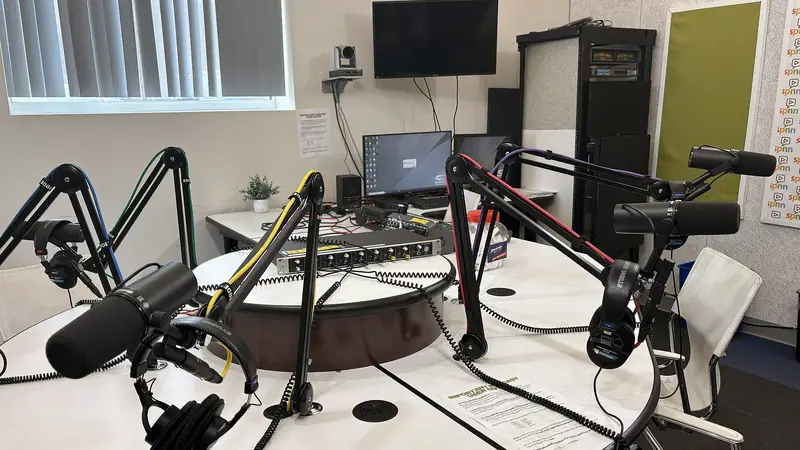
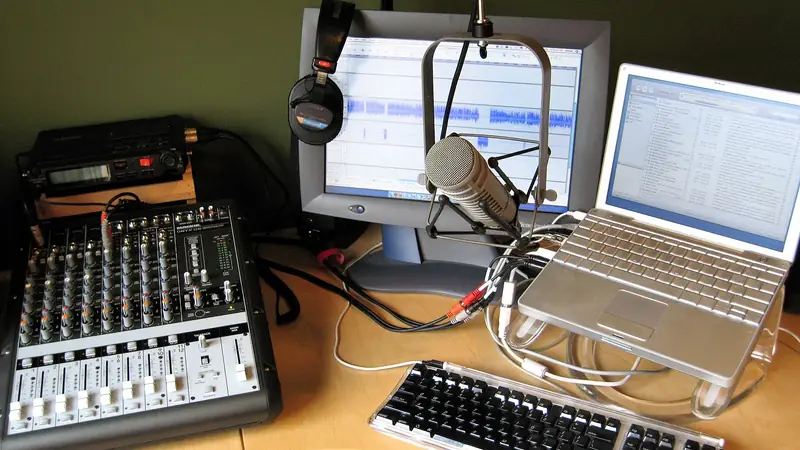
You need a quiet room with soft surfaces, a quality microphone with a pop filter, closed-back headphones and recording software. Spend first on the room, because no microphone can remove traffic, echo or a humming refrigerator after the fact.

Here is a practical home setup:
- A quiet, dead room. A walk-in closet full of clothes is a classic choice. Rugs, blankets and acoustic panels reduce echo.
- A microphone. Many narrators use a large-diaphragm condenser or a broadcast dynamic microphone. XLR models need an audio interface; USB models plug straight into a computer.
- A pop filter and stand. These control plosive "p" and "b" sounds and keep your distance consistent.
- Closed-back headphones. You need to hear exactly what the microphone hears.
- Recording and editing software that can export the files your distributor needs.
- A tablet or quiet screen for your script. Paper rustles.
The finished files must meet strict specifications. The ACX audio submission requirements call for an average loudness between -23dB and -18dB RMS, peaks no higher than -3dB, and a noise floor no higher than -60dB RMS. Those numbers sound technical, but they boil down to steady volume and a silent room.
How do you narrate your own audiobook step by step?
Start small with a test chapter, then commit to the full book only if the results meet specifications and sound like a book you would buy. This sequence keeps you from investing 50 hours in an approach that does not work.
- Finalize your manuscript. Changes after recording mean re-recording, so lock the text.
- Prepare the script. Mark breaths, emphasis and tricky words. Build a pronunciation list.
- Treat your room and set levels. Record a minute of silence and check the noise floor.
- Record a test chapter. Use a chapter with dialogue or emotion, not the easiest one.
- Get honest feedback. Ask a producer or experienced narrator to review the test for performance and technical quality.
- Record in consistent sessions. Same room, same microphone position, same time of day if you can, so your voice matches across chapters.
- Edit and proof listen. Follow along with the text and log every misread line.
- Record pickups in the same setup so they blend in.
- Master the files to retailer specifications and add opening and closing credits.
- Upload and review. Our guide on how to turn your book into an audiobook covers distribution choices and the full checklist.
How do you judge whether your test chapter is good enough?
Judge your test chapter on two things: whether the audio meets the technical specifications, and whether a stranger would happily keep listening for eight hours. If either answer is no, fix the problem before recording the rest of the book.
Use this checklist after your test session:
| Check | What "good" sounds like |
|---|---|
| Room noise | Silence between sentences, with no hum, traffic, echo or computer fan |
| Volume | Steady loudness from the first page to the last, with no sudden jumps |
| Pace | Calm and conversational, with time for key lines to land |
| Clarity | Every word understandable on earbuds and in a car |
| Mouth noise | Few clicks, smacks or loud breaths |
| Character voices (fiction) | Each speaker recognizable without being a caricature |
| Energy | The last paragraph sounds as engaged as the first |
Listen back the next day, not straight after recording, and listen on the devices your readers use. Then ask someone who does not know the book to listen to ten minutes and tell you where their attention drifted. Honest feedback at this stage saves dozens of hours later.
How do you protect your voice during a long recording project?
Protect your voice by recording in limited sessions, staying hydrated, and stopping when your tone changes. A tired voice sounds different from a fresh one, and listeners notice the shift between chapters.
- Warm up with gentle humming and reading aloud for a few minutes before each session.
- Keep room-temperature water nearby and sip between pages.
- Schedule sessions at the same time of day so your voice has a similar character throughout the book.
- Stop when your voice drops, rasps or speeds up, and pick up the next day.
- Avoid recording when you have a cold, since the change in tone is hard to match later.
What mistakes do authors make when narrating their own books?
The most common mistakes are reading too fast, recording in a noisy or echoing room, and letting volume and tone drift between sessions. All three are fixable with preparation.

- Rushing. Nerves speed you up. Listeners need a calm, conversational pace.
- "Reading voice." Aim to tell the story to one person across the table, not to perform at them.
- Mouth noise. Hydrate, avoid dairy and salty food before sessions, and keep water nearby.
- Inconsistent sessions. Moving the microphone even a few inches changes your sound.
- Skipping the proof listen. Authors know their text so well they hear what they meant, not what they said. A second listener catches it.
- Over-editing. Removing every breath makes speech sound robotic. Keep natural pauses.
According to Backstage's guide to PFH rates, even beginners on ACX may need about ten hours per finished hour once post-production is included, while experienced narrators need about six. Be patient with yourself on the first chapters.
Is there a middle path between doing it yourself and hiring a narrator?
Yes. You can perform the narration while a producer handles direction, editing, proof listening and mastering. This hybrid path keeps your voice on the book while removing most of the technical burden.
Common hybrid options include:
- Record at home, outsource post-production. You deliver raw takes; a producer edits and masters.
- Rent a professional studio with a director. You perform in a treated booth while an engineer and director guide pacing and catch errors live.
- Share the narration. You read a personal introduction, foreword or afterword, and a professional narrates the main text.
That last option is popular for memoirs and business books: listeners hear the author's voice up front, and the long-form narration benefits from professional stamina. For budgets on the professional side, see our guide to audiobook narration cost per finished hour.
How Cassell Publishers can help
Cassell Publishers supports authors whichever voice ends up on the book. If you want to narrate, we can coach your test chapter, direct your sessions, and handle editing, proof listening and mastering so your files meet retailer specifications. If a professional voice is the better fit, our audiobook narration team casts and auditions narrators matched to your genre and tone.
Explore our full audiobook production process, or see everything we offer on our audiobook page. The simplest first step is a complimentary consultation: send us a short sample of you reading aloud, and we will give you an honest view of which path suits your book.
The right narrator is the one who makes listeners forget they are listening, and sometimes that is you.
Frequently asked questions
Is it a good idea for authors to narrate their own audiobooks?
It is often a good idea for memoir, personal development, business and ministry books, where listeners want to hear the author directly. It is usually a weaker choice for fiction with many characters, accents or emotional range. The deciding factors are your reading skill, your available time and whether you can record in a truly quiet space.
How long does it take to record your own audiobook?
ACX says new narrators generally take five to seven hours of work to produce one finished hour. An 80,000-word book runs about 8.6 finished hours, so expect roughly 43 to 60 hours of recording, editing and review, spread over several weeks to protect your voice.
What equipment do I need to narrate an audiobook at home?
You need a quiet, soft-surfaced room, a quality microphone with a pop filter, closed-back headphones and recording software that exports constant bit rate MP3s. Many narrators use an XLR microphone with an audio interface. The room matters more than the microphone, because the files must hold a noise floor at or below -60dB.
Can I narrate my audiobook and still hire someone to edit it?
Yes, and this hybrid path suits many authors. You record the performance at home or in a rented studio, and a producer handles editing, proof listening, pickups lists and mastering to retailer specifications. It saves the hardest technical work while keeping your own voice on the book.
Will listeners mind if the author is not a professional narrator?
For nonfiction and memoir, many listeners prefer the author's voice even without professional polish, provided the audio is clean and the pace is steady. Listeners are less forgiving of noise, uneven volume and rushed delivery. In fiction, a flat performance of dialogue is more noticeable and more likely to draw criticism in reviews.
Sources
- ACX's guide to paying for audiobooks acx.com
- ACX's production guidance help.acx.com
- ACX audio submission requirements help.acx.com
- Backstage's guide to PFH rates backstage.com