

On this page
- Key takeaways
- What does "per finished hour" mean in audiobook narration?
- How many finished hours will your audiobook be?
- What do audiobook narrators charge per finished hour?
- What is included in an audiobook production rate?
- Royalty share or pay for production: which costs less?
- What other audiobook costs should you budget for?
- How do you budget for your audiobook step by step?
- What mistakes make audiobooks cost more than planned?
- Is an audiobook worth the cost for a first-time author?
- How Cassell Publishers can help
- Frequently asked questions
- Sources
Most professional audiobook narration costs about $200 to $400 per finished hour (PFH), and union narrators on ACX start at $250 PFH. One finished hour is roughly 9,300 words, so a 70,000-word book runs about 7.5 hours and typically costs between $1,500 and $3,000 to narrate and produce.
That number is only useful if you know what is inside it. Below, you will find the math, a cost table by word count, and the trade-offs between paying upfront and sharing royalties.
What changed in this update (November 10, 2026): we added a 40,000, 80,000 and 120,000 word budget matrix at four rates, the effective hourly rate behind PFH pricing, and a complexity surcharge for accents and multi-voice casts.
Key takeaways
- Narrators quote by the finished hour, meaning one hour of final, edited audio, not hours spent in the booth.
- Estimate your running time by dividing your word count by 9,300.
- A produced rate (recording plus editing and mastering) is different from a narration-only rate. Compare like with like.
- Royalty share removes the upfront cost but locks you into seven years of exclusive distribution and a split royalty.
- Budget for the extras too: square cover art, proof listening, corrections, and marketing.
What does "per finished hour" mean in audiobook narration?
Per finished hour (PFH) pricing charges for each hour of final, edited audio, not recording time. If your finished audiobook runs eight hours, a $250 PFH quote equals $2,000.
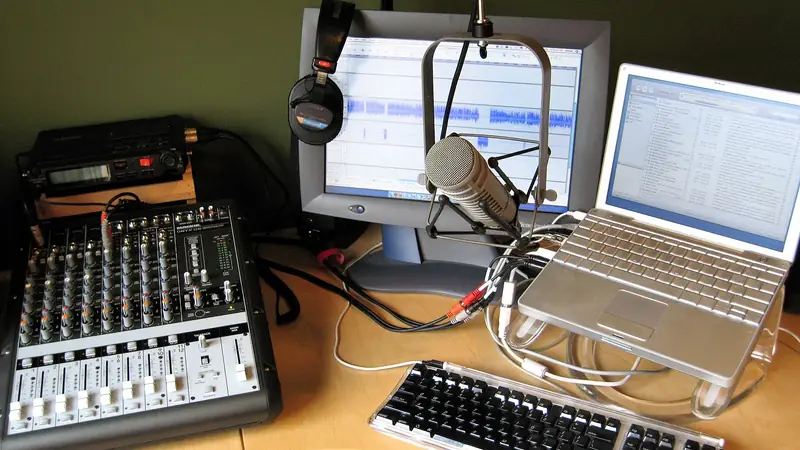
This pricing model protects you. A narrator may spend many hours recording, re-reading flubbed lines and editing breaths, but you only pay for the finished result. According to ACX's guide to paying for audiobooks, it can take about four hours of work to produce one finished hour: roughly two hours in the booth and two to three hours editing, mixing and mastering.
Other estimates run higher. Author's Republic says a finished hour "can take six or more hours of work," so a 10-hour audiobook can take upwards of 60 hours. That ratio explains why PFH rates look high: a $300 PFH rate spread across four to six working hours is about $50 to $75 per hour of skilled labor, before equipment and studio costs.
How many finished hours will your audiobook be?
One finished audiobook hour holds about 9,300 words, so divide your word count by 9,300. ACX uses the same figure, noting that most performers narrate about 9,300 words per hour.
Pace varies with genre. Thrillers with fast dialogue may run a little quicker, while poetry, scripture-heavy texts and technical nonfiction often run slower because the narrator needs room for meaning to land. Treat the estimate as a planning number, then let your narrator confirm it after a sample.
Here is what that means for your budget at four common rate levels, including the $250 union minimum.
| Manuscript length | Est. finished hours | At $200 PFH | At $250 PFH | At $300 PFH | At $400 PFH |
|---|---|---|---|---|---|
| 40,000 words (novella, short nonfiction) | 4.3 | about $860 | about $1,080 | about $1,290 | about $1,720 |
| 50,000 words (business book) | 5.4 | about $1,080 | about $1,340 | about $1,610 | about $2,150 |
| 70,000 words (memoir, many novels) | 7.5 | about $1,510 | about $1,880 | about $2,260 | about $3,010 |
| 80,000 words (full-length novel) | 8.6 | about $1,720 | about $2,150 | about $2,580 | about $3,440 |
| 120,000 words (epic fantasy, history) | 12.9 | about $2,580 | about $3,230 | about $3,870 | about $5,160 |
Cost figures in this guide are independent industry ranges for planning, not Cassell Publishers pricing.
Final invoices use the actual running time, so your cost may land slightly above or below these estimates.
What do audiobook narrators charge per finished hour?
Most professional rates fall between $200 and $400 PFH, with union narrators on ACX starting at $250. Rates rise with experience, union status, genre demands and whether the quote includes full production.
Backstage's breakdown of PFH rates reports that production houses and publishers commonly pay narrators $180 to $250 PFH, that the SAG-AFTRA minimum on ACX is $250 PFH, and that $300 PFH is a fair rate for an experienced narrator. ACX itself describes roughly $200 PFH for narration plus about $200 PFH for post-production.
Here is how those numbers translate into tiers you are likely to see.
| Tier | Typical quote | What you usually get |
|---|---|---|
| Newer independent narrator | Around $200 PFH or less | Developing performer, often self-produced; quality varies widely, so audition carefully |
| Experienced independent narrator | Around $250 to $400 PFH | Reliable performance and clean production; many deliver retailer-ready files |
| Union (SAG-AFTRA) narrator | From $250 PFH on ACX | Professional performer; may require health and retirement contributions on top |
| Studio or full-service production | Quoted per project | Casting, direction, engineering, proof listening and mastering handled by a team |
| Complex project surcharge | Add 20 to 40% to the base rate | Heavy accents or dialects, multiple character voices, dense technical vocabulary |
The surcharge range comes from VoiceBros' narrator rate guide, which advises budgeting an additional 20 to 40 percent for complex projects. On an 80,000-word novel at $300 PFH, that turns about $2,580 into roughly $3,100 to $3,610.
Be wary of quotes far below these ranges for a long book. Very low rates often mean the edit, the proof listen or the mastering has been skipped, and those gaps show up later as rejected files or poor listener reviews.
What is included in an audiobook production rate?
A full production rate usually covers recording, editing, proof listening, corrections and mastering. A narration-only rate covers the performance alone. Ask which one you are being quoted before comparing prices.

Here is what a complete production includes:
- Preparation: reading the book, building a pronunciation list, and agreeing on character voices or tone.
- Recording: the performance itself, usually in a treated booth.
- Editing: removing mistakes, breaths, mouth clicks and long pauses.
- Proof listening: a separate listener follows the text and flags misreads.
- Pickups: re-recording the flagged lines so they match the original sessions.
- Mastering: bringing every file to retailer specifications for volume, peaks and noise.
If any of those steps are not in the quote, you will either pay for them separately or do them yourself. Proof listening is the step authors most often skip, and it is the one listeners notice when a word is misread.
Royalty share or pay for production: which costs less?
Paying an audiobook producer upfront costs more on day one but usually less over the book's life. Royalty share costs nothing upfront, but you split your royalties for seven years and must stay exclusive to Audible, Amazon and Apple Books.
ACX introduced a new royalty model in 2026. According to ACX's royalty help page, rights holders who pay for production now earn 50 percent with exclusive distribution or 30 percent with non-exclusive distribution, up from the legacy 40 and 25 percent. Under royalty share, the 50 percent is divided equally, so you and the producer each receive 25 percent, and the producer is paid for seven years.
ACX also offers Royalty Share Plus, a middle path. ACX explains that these offers pay the narrator a per-finished-hour rate of at least $100 plus an equal split of royalties.
| Deal type | Upfront cost | Your royalty (new model) | Distribution | Can you change it later? |
|---|---|---|---|---|
| Pay for production, exclusive | Full PFH fee | 50% | Audible, Amazon, Apple Books only | One-time switch after 90 days on sale |
| Pay for production, non-exclusive | Full PFH fee | 30% on ACX channels | ACX channels plus any other retailer or library | One-time switch after 90 days on sale |
| Royalty Share Plus | Reduced PFH fee (from $100) | 25% (split equally) | Exclusive only | No |
| Royalty share | None | 25% (split equally) | Exclusive only | No |
Two points matter most. First, royalty share and Royalty Share Plus agreements cannot be switched to non-exclusive, which means no library distribution and no wide retail for the full term. Second, ACX notes that its exclusive distribution term is seven years, so a royalty share decision is a long one.
What other audiobook costs should you budget for?
Besides narration, audiobook budgets need cover art, corrections, distribution decisions and marketing. Most of these are modest compared with narration, but they add up if you have not planned for them.
- Square cover art. Audiobook retailers need a 1:1 cover, so your ebook or print cover must be adapted. Ask your cover designer to include this in the original brief.
- Script preparation. A clean, final manuscript with visual references, tables and URLs rewritten for the ear saves expensive pickups.
- Author review time. Listening to the full audiobook and logging corrections takes as long as the audiobook itself.
- Music or sound design. Optional for most books, common for children's titles and some nonfiction.
- An ISBN for the audio edition. Optional on some platforms, but useful if you distribute widely, because one identifier then follows the edition everywhere.
- Launch marketing. Promo codes, listener samples, and announcements to your readers. See our audiobook marketing service for what a campaign includes.
How do you budget for your audiobook step by step?
Budget an audiobook by starting with word count, then a rate band, extras and a contingency. This six-step process gives you a realistic number before you speak to a narrator.
- Get your final word count. Use the edited manuscript, not a draft. Subtract front matter you will not narrate, such as the table of contents.
- Estimate finished hours. Divide by 9,300 and round up.
- Pick a rate band. Use around $200 PFH for a lean budget, $250 to $300 PFH for an experienced independent narrator, and $300 to $400 PFH or a project quote for full production with proof listening.
- Multiply. Finished hours times rate gives your core production cost.
- Add extras. Cover adaptation, any music, an audio ISBN, and launch marketing.
- Add 10 to 15 percent contingency. Running times can come in long, and script changes after recording trigger pickups.
For a 70,000-word memoir at $300 PFH, that looks like 7.5 hours times $300, or about $2,260, before extras and contingency.
What mistakes make audiobooks cost more than planned?
The costliest audiobook mistakes are post-recording text changes, price-only narrator choices and skipped proof listens. Each one creates rework you pay for twice.

- Editing after recording. Every changed sentence becomes a pickup session. Lock the text first.
- Not auditioning. Ask for a custom audition of a tricky passage: dialogue, accents, names, or technical terms.
- Ignoring the contract. Confirm the number of correction rounds, the delivery format, and who owns the recordings.
- Assuming royalty share is "no cost." Over seven years, half of your royalties may far exceed a one-time fee.
- Forgetting the platform rules. Files that miss technical specifications are sent back for fixes. Our step-by-step guide on how to turn your book into an audiobook walks through each requirement.
Is an audiobook worth the cost for a first-time author?
An audiobook is often worth the cost, because the US audio audience is large and growing. Whether it pays back depends on your genre, your existing readership and how you price and promote the audio edition.
The Audio Publishers Association reported that US audiobook sales rose 9 percent in 2025 to $2.43 billion, and its consumer survey estimates that 58 percent of American adults have listened to an audiobook. Competition is growing too, with publishers reporting more than 750,000 active titles.
Memoir, business, self-help and faith titles often do well in audio because listeners value hearing the author's story or teaching directly. If your voice is part of the appeal, read our honest look at whether you should narrate your own audiobook before you hire.
How Cassell Publishers can help
Cassell Publishers produces audiobooks from manuscript to retailer-ready files, including casting, direction and mastering. We also handle script preparation, auditions, editing, proof listening, square cover adaptation and distribution set-up. You keep your rights and your royalties, and you see a clear, itemized quote before anything is recorded.
If you want to compare options first, explore our audiobook narration service and our wider audiobook production process. Our Author Support Program offers up to 50% publishing funding for eligible authors, subject to editorial review. Or book a complimentary consultation and we will estimate your running time and budget together.
A well-planned audiobook budget is simply word count, rate and honest extras, and once you know those three numbers, the decision gets much easier.
Frequently asked questions
How much does it cost to narrate an audiobook per finished hour?
ACX describes roughly $200 per finished hour for narration plus about $200 for post-production, and calls $300 to $400 per finished hour a reasonable combined rate. Union narrators working through ACX have a $250 minimum. Established narrators and full-service studios typically quote above that, so get written quotes that state exactly what the rate includes.
How many words are in one finished hour of audio?
ACX says most performers narrate about 9,300 words per finished hour. Divide your manuscript word count by 9,300 to estimate running time. A 70,000-word book comes out at roughly 7.5 finished hours, which is the number a narrator multiplies by their per-finished-hour rate to quote your project.
Is royalty share cheaper than paying a narrator upfront?
Royalty share costs nothing upfront, but you split royalties with the producer for seven years and must distribute exclusively through Audible, Amazon and Apple Books. Under ACX's new model each party receives 25 percent. If the book sells steadily, paying upfront usually costs less over the full term and keeps your options open.
What does a per-finished-hour rate include?
It depends on the quote. A produced rate usually covers recording, editing, proof listening, corrections and mastering to retailer specifications. A narration-only rate covers the performance alone, and you pay separately for editing and mastering. Always confirm how many correction rounds are included and who pays for retakes caused by script changes.
How long does it take to produce an audiobook?
ACX estimates about four hours of work for each finished hour from an experienced producer, and five to seven hours for new narrators. Add casting, scheduling and retailer review, and most author projects take several weeks to a few months from signed agreement to listing.
Can I get help paying for audiobook production?
Some hybrid publishers co-fund production. Cassell Publishers offers up to 50% publishing funding for eligible authors, subject to editorial review, through its Author Support Program. Royalty share deals on ACX are another way to avoid upfront costs, though you give up half of your royalties for the term.
Sources
- ACX's guide to paying for audiobooks acx.com
- Author's Republic authorsrepublic.com
- Backstage's breakdown of PFH rates backstage.com
- VoiceBros' narrator rate guide voicebros.com
- ACX's royalty help page help.acx.com
- ACX explains acx.com
- Audio Publishers Association reported shelf-awareness.com